
Long-term policy and infrastructure decisions under deep uncertainty
When decisions rely on assumptions that may prove wrong over time
Challenge
Once decisions are made, their consequences unfold over many years and are difficult to undo. When planning infrastructure projects, capacites, or designing investments, it is particularly important to assess uncertainties in order to be able to classify decisions. Relying on a single forecast or business case hides risk and creates false confidence. What matters is understanding how decisions perform across many possible futures.
Outcome
For decisions under deep uncertainty, this work focuses on making explicit how outcomes vary across scenarios, assumptions, and conditions:
- clear understanding of scenario outcomes
- explicit assumptions and quantified uncertainty
- visibility into risk, robustness, and downside exposure
- decisions that remain credible when conditions change
Large decisions have consequences that depend on many uncertain factors. We show what can go wrong, how likely it is, and how strongly it affects outcomes.
Who this is for
This work focuses on contexts that…
- make long-term, capital-intensive decisions
- operate in complex, uncertain systems
- carry responsibility for reliability, resilience, or long-term system stability
Typical applications include…
- energy and infrastructure systems
- capacity and asset planning
- public planning and regulation
- strategic investment and portfolio decisions
Our approach
Our approach builds on the Robust Decision Making (RDM) research tradition, focusing on how decisions perform across many plausible futures. Applied methods combine:
- Stochastic Modeling (e.g. Monte Carlo Simulation)
- Robustness metrics and sensitivity analysis (e.g. regret, threshold performance)
- Stress testing (extreme and compund scenarios)
- Distributional and tail risk analysis (downside risk, fat tails)
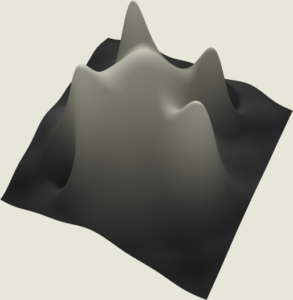
A decision is not a point.
It is a landscape.
Viewing decisions as landscapes shifts the focus from identifying a single optimal solution to understanding how choices perform across many plausible futures. The following analyses illustrate how this perspective reveals robustness, vulnerabilities, and critical trade-offs in long-term policy and infrastructure decisions.
Quantifying grid stress beyond averages
This example illustrates how infrastructure planning decisions change when rare but persistent stress conditions are treated explicitly rather than averaged away.
Problem
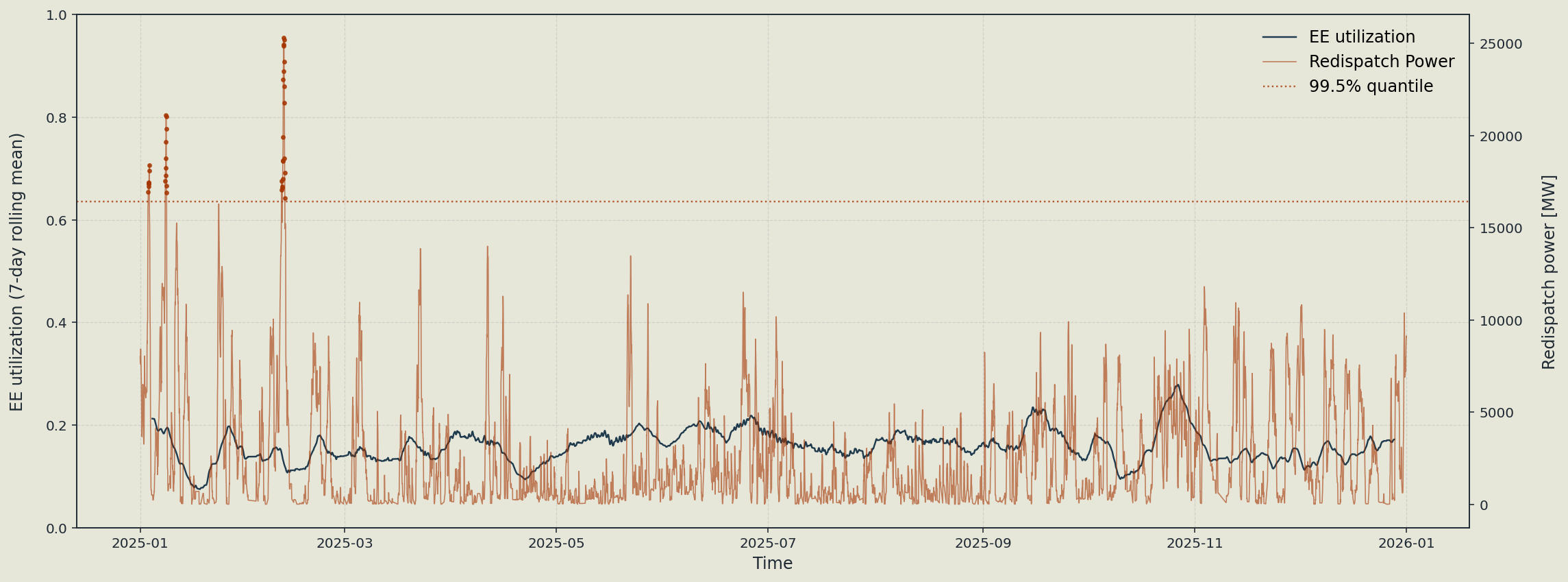
The figure below illustrates a key challenge in power system planning: increasing utilization of renewable energy capacities can be accompanied by substantial grid stress. While renewable energy utilization evolves smoothly over time, redispatch requirements are highly episodic and dominated by extreme events occurring during a relatively small number of hours. Especially during winter months, redispatch power regularly exceeds the 99.5% quantile. This shows that grid stress is not driven by average system conditions, but by rare and persistent combinations of seasonal renewable generation, demand patterns, and network constraints.
This mismatch between smooth averages and spiky extremes poses a fundamental challenge for system planning. Approaches based on mean values or typical scenarios systematically fail to capture the conditions under which operational risks, congestion costs, and system vulnerabilities actually emerge.
Note: Renewable generation and capacity data are taken from the German electricity market transparency platform SMARD, operated by the Bundesnetzagentur. Redispatch data for the German transmission system are provided via the Netztransparenz platform and transformed into hourly intervals by allocating reported energy volumes proportionally over the duration of each redispatch measure.
Challenge
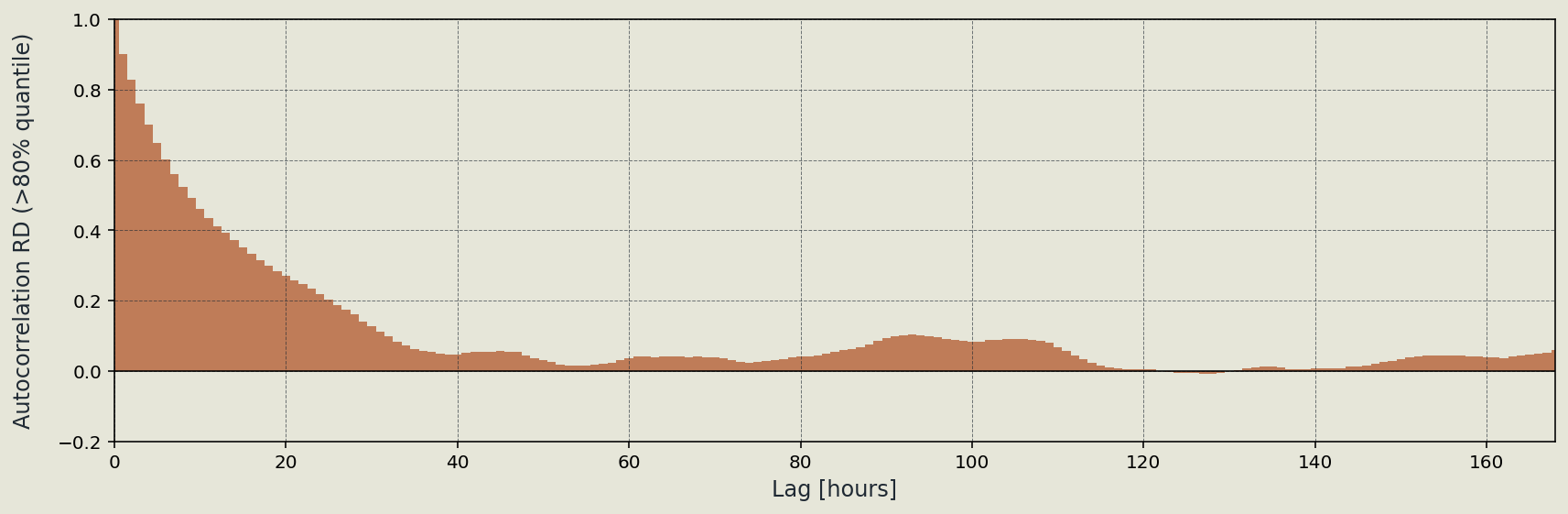
Complex energy systems do not behave like independent sequences of hourly values. Instead, they exhibit memory-like behavior: once the system enters a stressed state, elevated redispatch activity tends to persist over many consecutive hours or even several days.
This temporal dependence is clearly visible in the autocorrelation of redispatch measures above the 80% quantile. High grid stress is not the result of isolated events, but emerges from persistent conditions such as weather regimes, correlated renewable generation patterns, and structural network constraints. These conditions evolve slowly and cannot be captured by static snapshots or average-based indicators.
For system planning, this poses a fundamental challenge. Many traditional approaches implicitly assume that extreme situations are rare, short-lived, and statistically independent. In reality, operational risk accumulates over time as stress clusters and compounds. Ignoring this structure leads to a systematic underestimation of congestion costs, reserve requirements, and infrastructure needs.
Solution
To address this challenge, we move beyond average scenarios and isolated peak events and focus on persistent system dynamics. Our approach models renewable utilization as a persistent stochastic process calibrated to observed temporal patterns in historical data. This allows us to represent realistic system trajectories rather than idealized, statistically independent hours.
Redispatch is sampled from empirically observed distributions conditional on the simulated system state. In this way, both the level and variability of renewable utilization are directly linked to operational grid stress in a data-driven manner. The resulting simulations capture not only expected outcomes, but also the accumulation of risk over extended stress periods.
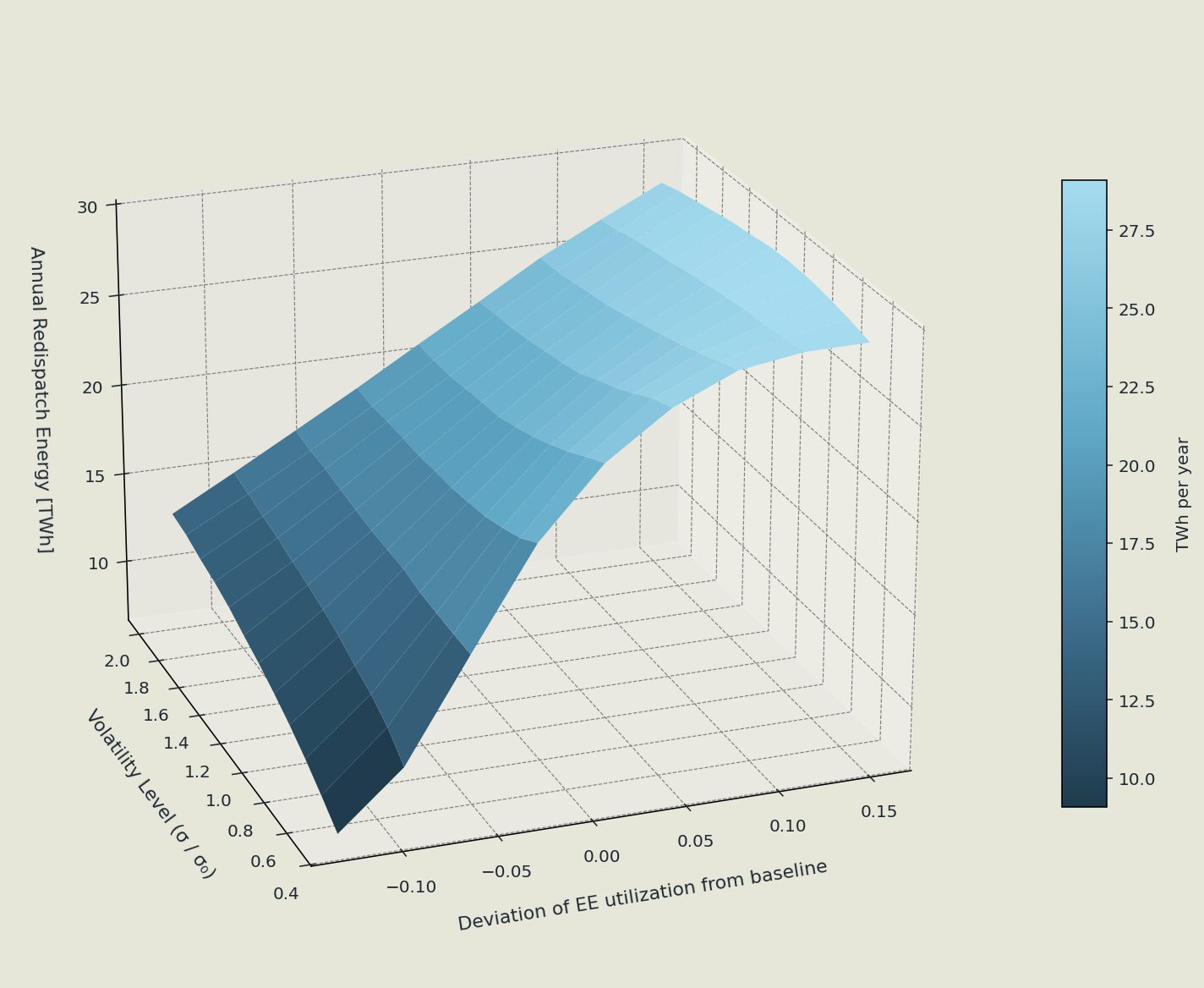
By systematically varying the average level and volatility of renewable utilization, we derive a sensitivity surface that quantifies how annual redispatch volumes scale under different system regimes. This transforms complex, path-dependent dynamics into a transparent decision space.
Instead of asking whether a single scenario is “acceptable”, the analysis reveals where operational risk grows rapidly, where the system remains robust, and where trade-offs between renewable integration and system stability become critical. This enables planners and decision-makers to identify resilient strategies, prioritize network reinforcement, and evaluate investments under realistic uncertainty.
Water Supply Planning under Hydrological Uncertainty
This example illustrates how long-term water supply decisions change when uncertainty is treated as persistent and path-dependent rather than averaged over.
Challenge
Water supply systems operate under a combination of high climatic variability, growing demand pressures, and strict operational constraints. For instance, in California large surface reservoirs play a central role in balancing seasonal inflows, interannual drought risk, and downstream water demands for municipalities, agriculture, and ecosystems.
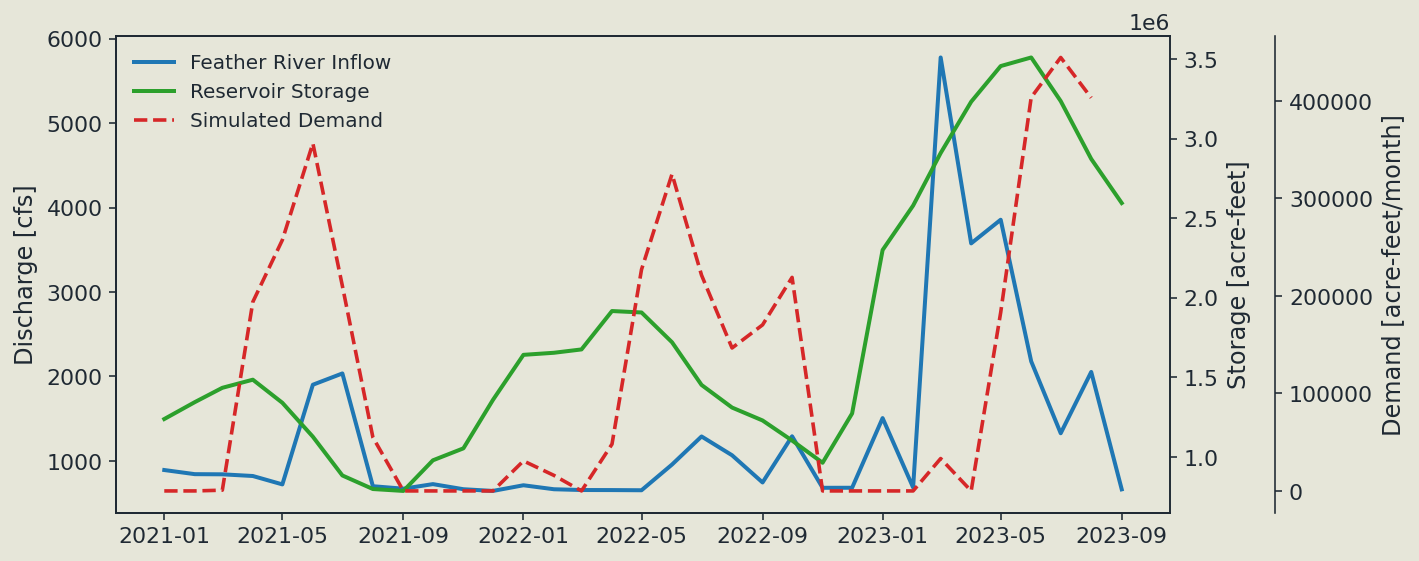
The figure below illustrates this challenge using Lake Oroville, one of California’s largest reservoirs, which is primarily supplied by the Feather River. The time series shows historical monthly inflow to the reservoir, observed storage levels, and a simulated aggregate water demand that must be met through reservoir releases. This demand represents the operational control variable in the system and reflects the volume of water supplied to downstream users under different management policies.
A defining challenge for reservoir management arises from rare and persistent events, such as multi-year droughts, delayed snowmelt, or unusually dry winters. Periods of sustained high demand further reduce system resilience, especially when they coincide with unfavorable inflow sequences. These conditions are not well represented by average hydrological years.
Historical records from California’s reservoir Lake Oroville show that inflows and storage levels evolve smoothly most of the time, yet critical shortages emerge during relatively short episodes. During these periods, reservoir storage can decline rapidly, and recovery may take multiple seasons or years. Planning approaches based on long-term averages or “typical” years therefore may systematically underestimate the corresponding risk.
At the same time, future hydrological conditions are deeply uncertain. Climate change affects not only mean precipitation but also its timing, persistence, and sequencing. Snow-dominated systems, such as those feeding California’s reservoirs, are particularly sensitive to shifts in seasonal patterns. As a result, assigning reliable probabilities to future inflow sequences is often not defensible.
This creates a fundamental planning dilemma:
Demand management policies must be decided today, even though future inflow sequences, drought persistence, and demand pressures cannot be characterized by a single probabilistic forecast.
Note: The analysed data are publicly available on the website of the U.S. Geological Survey (USGS).
Solution
Simple forecasts based on averaged future conditions fail to capture the complexity of real-world water supply systems. The key question is therefore not what happens in an “average” future, but which demand management strategies remain reliable across many plausible futures under hydrological uncertainty.
Using historical observations of inflow to Lake Oroville, we generate many alternative future inflow trajectories that preserve key temporal characteristics such as seasonality, persistence, and drought clustering. These futures do not represent forecasts, but rather stress tests of the system. For each future, reservoir storage is simulated through a simple water balance, while demand is treated as the controlled decision variable. We then evaluate alternative demand management strategies by modifying how much water is released from the reservoir over time. Two broad classes of strategies are considered: Static and adaptive demand management.
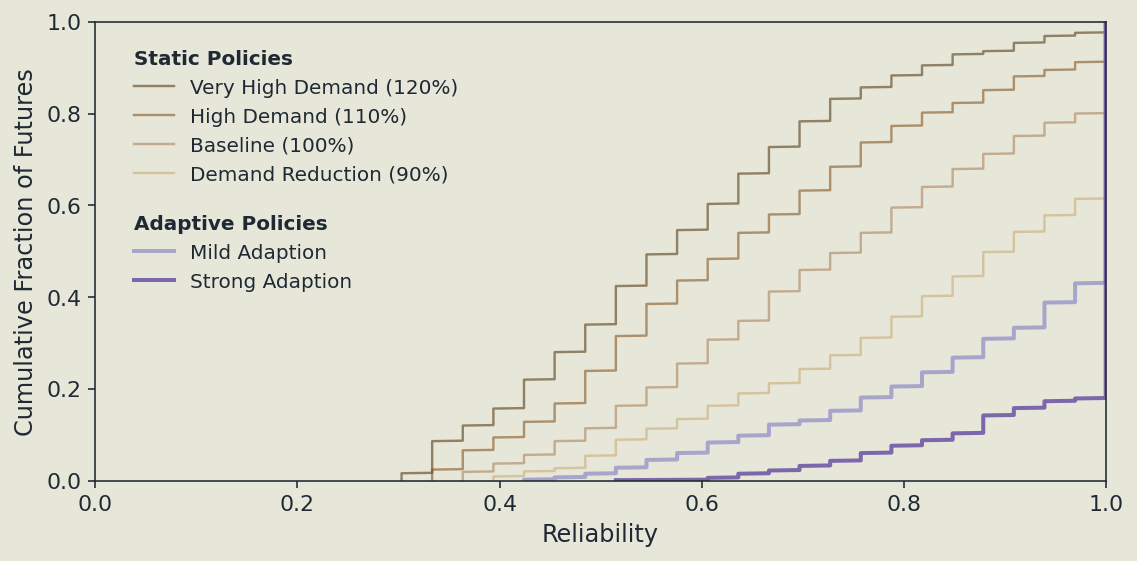
Static demand policies apply a fixed adjustment to demand throughout the planning horizon. Adaptive demand policies, in contrast, respond dynamically to system conditions: demand is reduced only when reservoir storage falls below predefined thresholds and relaxed again when storage recovers. The figure below summarizes system performance across all simulated futures using reliability, defined as the fraction of time that reservoir storage remains above a critical minimum level. Each curve shows the cumulative distribution of reliability outcomes across futures for a given policy.
Curves further to the right indicate more robust strategies: a larger share of futures achieve high reliability. The static policies exhibit substantial spread and overlap, indicating that fixed demand adjustments can perform well in some futures but fail severely in others. In contrast, the adaptive policies are consistently shifted toward higher reliability, particularly in the lower tail of the distribution.
This illustrates a key insight: adaptivity matters more than static scaling. While static demand reductions improve average performance, adaptive strategies substantially reduce the risk of prolonged shortages by responding to unfolding conditions rather than committing to a single assumption about the future. This approach reveals where strategies fail and to what extent. This enables decision-makers to identify demand management policies that remain effective across deep uncertainty.
Navigating Uncertainty
If you’re facing a decision shaped by uncertainty, trade-offs, or long-term consequences, a short conversation is often enough to clarify whether a more robust approach makes sense.
About
Mission
Robust Decisions is an independent analytical practice focused on supporting decision-making under deep uncertainty. Our work addresses systems in which outcomes depend sensitively on assumptions, interactions, and evolving conditions.
The work is led by Sven Kersch, whose background in theoretical physics informs a strong emphasis on quantitative modeling, structured reasoning, and the explicit treatment of uncertainty. The work sits at the intersection of system analysis, decision design, and real-world constraints, with a focus on situations where commitments are costly to reverse once outcomes begin to unfold.
Many of the most consequential decisions shaping modern societies are made under time pressure and incomplete information. Too often, risks are underestimated or only become visible after critical choices have already been made. Robust Decisions aims to make such risks explicit early so that organizations can act before uncertainty turns into irreversible failure.
Background & Experience
- Theoretical Physics
- Quantitative Modeling & Simulation
- Robustness Analysis
- Python & Applied Statistics